

Exclusive Private Tour: Explore Pompeii and the Amalfi Coast
711 activities · Italy
Pompeii, Italy, has 711 activities, tours and experiences to book. Don't miss: Stabiae, Villa of the Mysteries, House of the Faun, Shrine of the Virgin of the Rosary of Pompei. Also worth exploring nearby: Nocelle, Positano, Amalfi, Sorrento.
01Things to do
Must-see places

Stabiae
Archaeological site

Villa of the Mysteries
Roman villa

House of the Faun
Ruins

Shrine of the Virgin of the Rosary of Pompei
Catholic cathedral

Amphitheatre of Pompeii
Roman amphitheatre

Temple of Apollo
Temple
02Activities to book
The best experiences in Pompeii
 Top pick
 Deal
Deal Top pick
 Free cancellation
 Top pick
 Top pick
 Top pick
 Free cancellation
 -10%
-10% -5%
-5% Free cancellation
 Top pick
03Explore nearby
Nearby cities


Exclusive Private Tour: Explore Pompeii and the Amalfi Coast
Duration
9 h
Language
anglais, italien, espagnol
Guidance
Guide
Group
Private activity
Booking
Instant confirmation
Lead time
Book up to 4 h before departure
Ticket
Mobile or paper ticket accepted
Tickets
One per booking
Cancellation
Free cancellation available
Overview
Looking for an expert private guide and professional driver for a once-in-a-lifetime experience in Pompeii and the Amalfi Coast? You’ve just found it. What truly distinguishes this tour is the seamless blend of scholarly historical insight and refined, stress-free travel. In Pompeii, you will explore the ruins with a licensed guide, walking original Roman streets while discovering how daily life unfolded 2,000 years ago. From politics and religion to trade, family traditions, and social customs — through engaging storytelling that brings the ancient city vividly back to life. The journey continues along the Amalfi Coast, where you will enjoy a panoramic drive with time for scenic stops and memorable photographs. According to your preferences, we may visit Positano, and Sorrento or Amalfi and Ravello Flexibility and attention to detail are guaranteed. The itinerary can be planned in advance and adjusted throughout the day ensuring a truly personalized experience for you and your family.
What's included
- ✓Skip-the-line tickets in Pompeii - Only if you select the Premium Option - Guide and Tickets
- ✓Live Commentaries on board
- ✓Deluxe Mercedes MiniVan with all comforts, A/C, free wi-fi, fresh water, super clean and sanitized
- ✓Licensed Professional (N.C.C) Driver/Guide for the entire day
- ✓Licensed Private Tour Guide in Pompeii - only if you select Prime Option Guide and Tickets
Not included
- ✕Private Guide in Pompeii - Unless you select the Prime Option - Guide and Tickets
- ✕Admission tickets in Pompeii - Unless you select the Prime Option - Guide and Tickets
- ✕Meals
Available options
Choose your option when you book.
Smart - Private Driver/Guide
from 155 €Deluxe Mercedes MiniVan: All Comforts, A/C, Super Clean Private Driver/Guide : Private English-Speaking Driver/Guide all tour long Pickup included
Prime - Guide and Tickets
from 226 €Private Guide in Pompeii Deluxe Mercedes MiniVan : All Comforts, A/C, and Super Clean Skip-the-line tickets included Pickup included
Itinerary
Archaeological Park of Pompeii
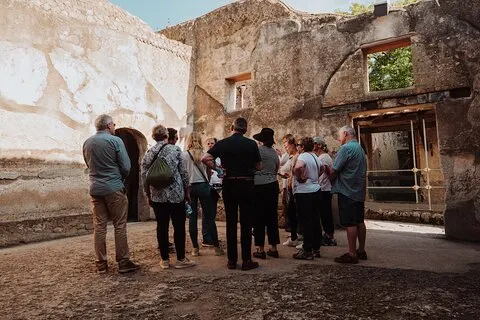
Your journey begins in legendary Pompeii, the “Buried City” frozen in time by the eruption of Mount Vesuvius in 79 AD. With your private licensed guide, enjoy a two-hour walk along original Roman streets, stepping into the daily lives of merchants, patricians, matrons, artisans, slaves, and gladiators. Through engaging storytelling and expert insight, ancient Pompeii comes vividly to life. Discover the Forum, Basilica, temples, marketplace, baths, bakeries, and wine bars that once formed the city’s vibrant heart. Enter private homes adorned with frescoes, mosaics, and elegant courtyards, revealing the sophistication and social structure of Roman society. Encounter the moving plaster casts of the victims, a powerful reminder of this historic tragedy. This exclusive experience is fully flexible and tailored to your pace and interests, ensuring a relaxed and deeply personal visit. In the event of limited time, the itinerary may be reversed, with Pompeii scheduled for the early afternoon.
· 2 h· Admission includedPiazza Porta Marina
he ancient walls of Pompeii once formed an impressive defensive system surrounding the city for nearly two miles. Originally built in the 6th century BC and later reinforced by the Romans, the walls featured imposing gates and towers that controlled access and protected this thriving commercial center. Today, walking along these fortifications offers a unique perspective over the archaeological site and toward Mount Vesuvius, allowing visitors to appreciate both the strategic importance of Pompeii and the dramatic landscape that ultimately shaped its destiny.
· 5 minBasilica
The Basilica was built between 120 and 100 BC, during Pompeii’s late Samnite period, before the Roman colony was established in 80 BC by Sulla. After colonization, it became the judicial heart of the Roman city. Here presided the duoviri, the two highest-ranking magistrates responsible for administering Roman law at the local level. The building reflects Rome’s expanding legal culture — even provincial cities operated within a highly structured judicial system. On any given morning, this space would have been crowded with litigants, lawyers, witnesses, and curious citizens. Disputes over property, inheritance, commercial contracts, and debts were argued publicly. Graffiti found here include political endorsements — evidence that Pompeii had competitive elections and active civic engagement. This was not a silent monument. It was loud, political, and intensely human.
· 10 min· Admission includedTemple of Apollo
The Temple of Apollo dates back to the 6th century BC, making it one of the oldest sanctuaries in Pompeii. Before Roman rule, the city was culturally influenced by Greek colonies in southern Italy, and Apollo’s cult reflects that Mediterranean network. After Pompeii became a Roman colony, the temple was renovated to align with Roman religious architecture, symbolizing political integration. Religion in Pompeii was not private — it structured the calendar. Festivals, sacrifices, and public rituals took place here. Citizens would offer incense or small sacrifices seeking divine favor for business success, marriage, or health. Priesthoods were prestigious roles. Religion, politics, and social ambition were closely connected.
· 10 min· Admission includedThe Forum was redesigned in the 2nd century BC and monumentalized after 80 BC, when Pompeii became a Roman colony. It was the symbolic and functional center of the city. Here stood temples, administrative buildings, and markets. Statues of emperors reinforced loyalty to Rome. Imagine the square filled with merchants, politicians, slaves running errands, children accompanying their parents. Announcements were read aloud. Elections were discussed. News from Rome — wars, imperial decrees, grain prices — circulated here. The Forum was Pompeii’s social media platform.
· 10 min· Admission includedMacellum
The Macellum, built in the 2nd century BC and renovated after the earthquake of 62 AD, was the main food market. In the early Imperial period, a shrine to the Imperial Cult was added inside, merging commerce with political ideology. Here you would buy fish from the Bay of Naples, pork, olives, lentils, fruit, and garum — the fermented fish sauce essential to Roman cuisine. The market was noisy and vibrant. Vendors called out prices. Buyers negotiated. Food tells us about status: wealthy households consumed exotic goods; modest families relied on bread, legumes, and seasonal produce.
· 10 min· Admission includedTerme del Foro
Constructed shortly after 80 BC, the Forum Baths were among the first major public investments of the Roman colony. Bathing culture was one of the most distinctive features of Roman urban life. The hypocaust heating system demonstrates advanced engineering and standardized Roman infrastructure. Bathing was a daily ritual for many citizens. Men and women bathed separately, moving from warm to hot to cold rooms. But baths were also social clubs. Business deals were discussed. Political alliances formed. Gossip circulated. Personal hygiene, relaxation, and networking all happened under one roof.
· 10 min· Admission includedHouse of the Small Fountain
The House of the Small Fountain is a refined private residence dating to the 1st century BC, renovated during the early Imperial period. It takes its name from the elegant mosaic fountain located in the peristyle garden, richly decorated with colorful glass paste and seashells — a striking display of taste and status. Though not among the largest homes in Pompeii, it reflects the aspirations of a comfortable middle-to-upper-class family. The layout follows the traditional Roman domus plan, with an atrium for receiving guests and a garden space designed for relaxation and social gatherings. In daily life, the house functioned as both private residence and semi-public space. Clients would visit the owner in the morning, while family life unfolded around the garden. The decorative fountain was more than ornamental — it symbolized refinement, hospitality, and the Roman desire to bring beauty and nature into the domestic sphere.
· 10 min· Admission includedMore than 80 thermopolia — ancient street-food counters — have been identified in Pompeii. Their high number reflects dense urban living and apartment housing without kitchens. Recent excavations have revealed detailed food remains and painted advertising panels. This was Pompeii’s fast food culture. Customers would stop for hot wine, stews, lentils, or meat dishes served in terracotta containers embedded in the counter. Graffiti nearby include jokes, love notes, and political commentary. It was informal, lively, and accessible across social classes.
· 5 min· Admission includedCasa dei Vettii
The House of the Vettii is one of Pompeii’s most celebrated residences, owned by the freedmen Aulus Vettius Restitutus and Aulus Vettius Conviva, who amassed wealth through trade, likely in wine. Originally built before the 1st century BC, it was lavishly redecorated after the earthquake of 62 AD in the vibrant Fourth Style, becoming a masterpiece of domestic art. In daily life, the house served both as a family home and a setting for social display. Guests were received in the atrium, banquets hosted in richly painted rooms, and rituals performed at the lararium. The peristyle garden, with fountains and statues, offered space for leisure and dining. Behind the elegance were kitchens and service quarters, reminding us that even elite homes depended on constant work and organization.
· 15 min· Admission includedOver 30 bakeries have been discovered in Pompeii, indicating large-scale urban demand. Grain was often imported from Sicily or North Africa, connecting Pompeii to imperial supply networks. Some bakeries show evidence of enslaved labor. Bread was the staple of the Roman diet. Bakers rose before dawn to grind grain and fire ovens. Carbonized loaves found in Pompeii were divided into sections — easy to portion and share. The smell of fresh bread would have filled the streets each morning.
· 10 min· Admission includedThe Insula dei Casti Amanti is a large urban block located along Via dell’Abbondanza, offering an exceptional glimpse into the mixed residential and commercial fabric of ancient Pompeii. It includes elegant domestic spaces, workshops, and a bakery, illustrating how different social and economic activities coexisted within a single neighborhood. The name derives from a fresco depicting two lovers exchanging a tender kiss during a banquet — a rare and intimate scene reflecting private social life. Recent excavations have revealed remarkable traces of daily routines: children’s charcoal drawings of gladiators and animals in a service courtyard, evidence of ongoing construction work after the earthquake of 62 AD, and the remains of victims found near a staircase. Together, these discoveries allow us to picture ordinary life here — family gatherings, business operations, children at play — abruptly interrupted in 79 AD.
· 15 min· Admission includedTeatro Grande
The Teatro Grande was originally built in the 2nd century BC during the Samnite period and later expanded under Roman rule, particularly in the age of Augustus. Designed to seat around 5,000 spectators, it took advantage of the natural slope of the land to create excellent acoustics and clear sightlines. In daily life, the theatre was a central place of entertainment and civic identity. Citizens gathered here for comedies, tragedies, musical performances, and public celebrations. Seating reflected social hierarchy — local elites sat closest to the stage, while women and lower-status spectators occupied the upper tiers. Performances were not only amusement but also moments of shared experience, reinforcing cultural values, political messages, and community bonds. On festival days, the area around the theatre would have been lively, filled with conversation, anticipation, and the energy of collective spectacle.
· 10 min· Admission includedParco Nazionale Del Vesuvio
While driving along the scenic coastline and exploring the ancient ruins, you will constantly be accompanied by the striking silhouette of Mount Vesuvius rising above the Bay of Naples. Its catastrophic eruption in 79 AD famously destroyed Pompeii and Herculaneum, preserving them beneath layers of ash and pumice. Still an active volcano today, Vesuvius remains one of the most studied and iconic in the world. Throughout the tour, you will have several opportunities to admire its dramatic profile and capture spectacular photographs — a powerful reminder of the force of nature that shaped the history of this extraordinary region.
· Non-stop passageSorrente
Sorrento is the perfect complement to a visit to Positano. Perched dramatically atop sheer cliffs overlooking the breathtaking Bay of Naples, Sorrento offers sweeping views framed by the unmistakable silhouette of Mount Vesuvius in the distance. Its charming Old Town features a spacious pedestrian area where historic churches and noble palaces are woven together by narrow, atmospheric alleyways. Here, elegant boutiques, fine jewelry stores, artisanal sandal workshops, and local craft shops invite leisurely browsing. The town is equally renowned for its excellent restaurants and cafés, making it an ideal setting to enjoy relaxed shopping time and a delightful lunch immersed in authentic southern Italian ambiance.
· 1 hf selected, Positano can be beautifully combined with a visit to Sorrento or Amalfi. Known as the “Vertical Village,” Positano cascades down the slopes of a dramatic limestone cliff, its pastel-colored houses rising in a striking pyramid-like silhouette above the sea. Before arriving, we may pause along the scenic Amalfi Drive to capture breathtaking panoramic views of the village from above — one of the most iconic perspectives of the coastline. Upon reaching the center, enjoy free time to wander through its charming, winding alleys lined with artisan ceramic shops, handmade sandal workshops, refined art galleries, and boutiques showcasing the elegant linen creations of the renowned Positano fashion style. Just steps away lies the beach, where you may choose to relax by the water or even take a refreshing swim. Positano is both sophisticated and untamed — a place where natural beauty and effortless Mediterranean elegance blend in perfect harmony.
· 1 hWe highly recommend including Amalfi while visiting Positano or, especially, Ravello. Amalfi is the historic heart of the Amalfi Coast and the town that gave its name to the entire shoreline. In the 9th century, it was a powerful Maritime Republic, expanding its influence across the Mediterranean and establishing trading colonies that brought wealth and prestige. Even today, Amalfi retains the atmosphere of a former capital — vibrant, elegant, and deeply rooted in its seafaring heritage. During your visit, you may explore the magnificent Cathedral of Saint Andrew, with its striking façade and grand staircase, and enjoy a leisurely stroll through the picturesque alleys of the old town. For lunch, choose one of the excellent seaside restaurants, or simply savor a refreshing local gelato. Do not miss the region’s signature dessert, the exquisite Delizia al Limone — a delicate lemon sponge cake that perfectly captures the essence of the Amalfi Coast.
· 1 hWe highly recommend including Ravello while visiting Positano or Amalfi. Perched high above the coastline, Ravello offers a quieter and more refined atmosphere, known for its breathtaking panoramic views and timeless elegance. In the Middle Ages, Ravello rivaled Amalfi in wealth and influence, becoming a prosperous center of trade and culture. Today, it is celebrated for its aristocratic villas and terraced gardens overlooking the sea. During your visit, you may explore the magnificent Villa Rufolo or Villa Cimbrone, both renowned for their spectacular gardens and unforgettable vistas that seem to suspend sky and sea in perfect harmony. A stroll through the peaceful main square and along the charming lanes reveals artisan boutiques, intimate cafés, and an authentic sense of local life. Ravello offers a serene and sophisticated experience — a place where history, beauty, and tranquility meet above the Mediterranean.
· 1 h
Pickup
Pickup included.
Pickup points: Hotel, Airport, Harbour, Place (958 stops served).
Pickup about 10 min before departure.
You can specify your pickup location when booking.
We pick up from hotels, vacation rentals, train stations, and cruise terminals/ports which are localized within the pick up area above described. Please specify the pick up place required while booking.
How to use your ticket
What to know before you go
- Infants and small children can ride in a pram or stroller
- Infants are required to sit on an adult’s lap
- Specialized infant seats are available
- Suitable for all physical fitness levels
- One day is not enough to explore the whole Amalfi Coast. I normally manage to stop in one or two of the villages. The suggested itineraries are Positano and Sorrento or Amalfi and Ravello, or Amalfi and Positano. Please, feel free to ask where would you like to stop and how long.
- The tour is totally private and customizable. There will be no-one else but your party and our driver-guide
- Please, wear comfy shoes for the visit of Pompeii and do not forget to bring sunblock for the summertime visits
- If a party member does not want to enter the ruins of Pompeii there is the chance to stay and wait in cafes and shops located just in front of the entrance of the Ruins.
Travelers
1 traveler(s) minimum · 7 maximum per booking.
At least one adult required per booking.
Cancellation policy
For a full refund, cancel at least 24 hours before the scheduled departure time.
- From 1 days before : 100% refunded
- From 0 days before : 0% refunded
Reviews
Product code: 309813P2
Activity offered by DangeloTour via Viator.