

Nara Customized Private Tour in 1 Day with Licensed Guide
132 activities · Japan
Nara, Japan, has 132 activities, tours and experiences to book. Don't miss: Tōdai-ji Temple, Yakushi-ji Temple, Kōfuku-ji Temple, Nara National Museum. Also worth exploring nearby: Uji, Osaka, Otsu, Kyoto.
01Things to do
Must-see places

Tōdai-ji Temple
Provincial temple

Yakushi-ji Temple
Buddhist temple

Kōfuku-ji Temple
Buddhist temple

Nara National Museum
National museum

Heijō Palace
Royal palace

Nara Park
Urban park
02Activities to book
The best experiences in Nara
 Top pick
 Top pick
 Private tour
 Private tour
 Private tour
 -30%Private tour
 Top pick
 Private tour
 Top pick
 Free cancellation
 Free cancellation
03Explore nearby
Nearby cities


Frequently asked questions about Nara
What is there to do in Nara?
Nara has 132 activities, tours and day trips you can book online. Among the most booked: « Nara Early Morning Tour Kyoto or Osaka Departure Available », « Kyoto Private Car Tour – Full Day with Local Guide & Nara Option », « Discover Ancient Nara: Private Car Tour from Kyoto or Osaka ».
What are the top-rated activities in Nara?
According to traveller reviews: « Sushi Making Experience Luxury Course in Nara » (5.0/5, 36 reviews) ; « Kyoto Private Car Tour – Full Day with Local Guide & Nara Option » (5.0/5, 33 reviews) ; « Nara: Half-Day Private Tour of 4 Must-See Spots & Deer Park » (5.0/5, 22 reviews).
What are the must-see places in Nara?
Not to be missed in Nara: Tōdai-ji Temple, Yakushi-ji Temple, Kōfuku-ji Temple, Nara National Museum, Heijō Palace, Nara Park.
Can you cancel an activity in Nara for free?
Usually, yes: 24 of the 24 most popular activities in Nara offer free cancellation. The exact terms are shown on each activity page before you book.
What is there to visit near Nara?
Close to Nara: Uji, Osaka, Otsu, Kyoto, Izumisano, Kobe.
Nara Customized Private Tour in 1 Day with Licensed Guide
Duration
6 h
Language
japonais, anglais
Guidance
Guide
Group
Private activity
Booking
Instant confirmation
Lead time
Book up to 2 days before departure
Ticket
Mobile or paper ticket accepted
Tickets
One per booking
Cancellation
Free cancellation available
Overview
Explore Nara with a government-licensed and experienced multilingual guide! Your guide will help you efficiently enjoy a half-day walking tour of Nara and introduce both modern and traditional sides of this dynamic and ancient Japanese city. Nara's proximity to Kyoto and Osaka, and its rich collection of traditional sites, make it an ideal destination for a day trip from either of its larger neighbors. Your private guide can help you efficiently enjoy a half-day walking tour of this ancient Japanese city. Note*1: Please select your must-see spots from a list in the tour information to create your customized itinerary. Note*2: The National Government Licensed Guide Interpreter certification is issued by the Japanese government requires a good knowledge and understanding of Japanese culture and history.
What's included
- ✓Meet up with guide on foot within designated area of Nara
- ✓Licensed Local English Speaking Guide
- ✓Customizable Tour of your choice of 3-4 sites from 'What to expect' list
Not included
- ✕Transportation fees, Entrance fees, Lunch, and Other personal expenses
- ✕Private Vehicle
- ✕You cannot combine multiple tour groups.
- ✕Guide Entry fees are only covered for sights listed under What to Expect.
Available options
Choose your option when you book.
Nara Customized Private Tour in 1 Day with Licensed Guide
from 44 000 JPYPickup included
Itinerary
Temple de Tōdai-ji
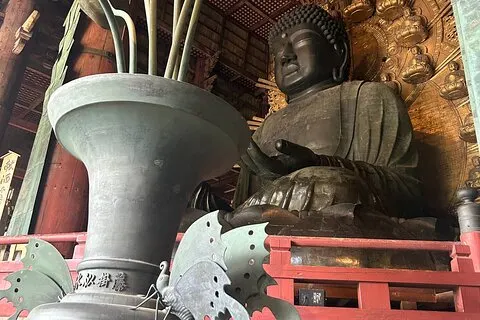
Todaiji (東大寺, Tōdaiji, "Great Eastern Temple") is one of Japan's most famous and historically significant temples and a landmark of Nara. The temple was constructed in 752 as the head temple of all provincial Buddhist temples of Japan and grew so powerful that the capital was moved from Nara to Nagaoka in 784 in order to lower the temple's influence on government affairs. Until recently, Todaiji's main hall, the Daibutsuden (Big Buddha Hall), held the record as the world's largest wooden building, despite the fact that the present reconstruction of 1692 is only two thirds of the original temple hall's size. The massive building houses one of Japan's largest bronze statues of Buddha (Daibutsu). The 15 meters tall, seated Buddha represents Vairocana and is flanked by two Bodhisattvas.
· 30 min· Admission not includedParc de Nara
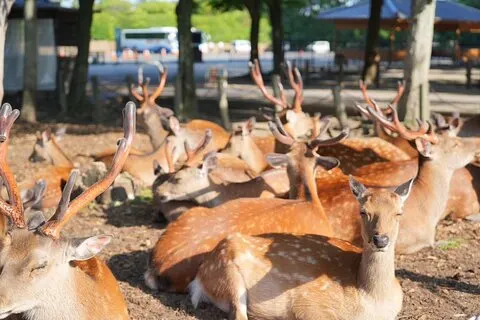
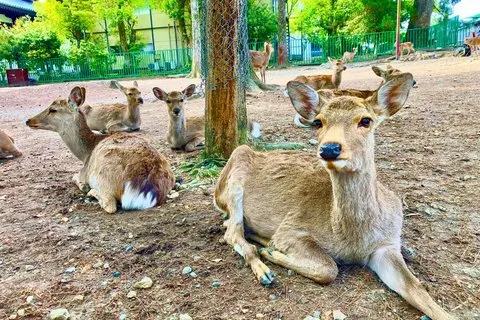
Nara Park (奈良公園, Nara Kōen) is a large park in central Nara. Established in 1880, it is the location of many of Nara's main attractions including Todaiji, Kasuga Taisha, Kofukuji and the Nara National Museum. It is also home to hundreds of freely roaming deer.
· 30 minKasuga Taisha (春日大社) is Nara's most celebrated shrine. It was established at the same time as the capital and is dedicated to the deity responsible for the protection of the city. Kasuga Taisha was also the tutelary shrine of the Fujiwara, Japan's most powerful family clan during most of the Nara and Heian Periods. Like the Ise Shrines, Kasuga Taisha had been periodically rebuilt every 20 years for many centuries. In the case of Kasuga Taisha, however, the custom was discontinued at the end of the Edo Period. Beyond the shrine's offering hall, which can be visited free of charge, there is a paid inner area which provides a closer view of the shrine's inner buildings. Furthest in is the main sanctuary, containing multiple shrine buildings that display the distinctive Kasuga style of shrine architecture, characterized by a sloping roof extending over the front of the building.
· 30 minMount Wakakusayama (若草山) is the grass covered mountain behind Nara Park, located between Todaiji Temple and Kasuga Shrine. The mountain is about 350 meters tall and affords unobstructed views over Nara City. Tourists are allowed to climb Mount Wakakusayama all year round except during winter. A small entrance fee is charged. The grassy slope of the mountain is lined by cherry trees that are usually in full bloom around early April. A steep trail leads along the leftmost edge of the slope to a plateau halfway up the mountain with great views over the city. It takes about 15-20 minutes to reach the plateau and many people do not hike farther. An additional 20-30 minutes would get you to the mountain's peak.
· 30 min· Admission not includedHoryu-ji Temple
Horyuji Temple (法隆寺, Hōryūji) was founded in 607 by Prince Shotoku, who is credited with the early promotion of Buddhism in Japan. Horyuji is one of the country's oldest temples and contains the world's oldest surviving wooden structures. It was designated a world heritage site in 1993. Horyuji's temple grounds are spacious and separated into two main precincts, the Western Precinct (Saiin Garan) and the Eastern Precinct (Toin Garan). Horyuji Temple is 1 hr approx from the Nara park area. Choosing to visit this temple may mean you are unable to visit other areas.
· 30 min· Admission not includedNaramachi
Naramachi (奈良町, literally "Nara Town") is the former merchant district of Nara, where several traditional residential buildings and warehouses are preserved and open to the public. Boutiques, shops, cafes, restaurants and a few museums now line the district's narrow lanes. Many of Naramachi's buildings in the Edo Period and earlier were machiya, long, narrow "townhouses" that served both as shops and as the living quarters of the local merchants. The store fronts of machiya were often kept narrow in order to save on taxes, which used to be calculated on a property's street access rather than its total area. Today, a handful of machiya have been preserved and made open to the public as museums.
· 30 minKofuku-ji Temple
Kofukuji (興福寺, Kōfukuji) used to be the family temple of the Fujiwara, the most powerful aristocratic clan during much of the Nara and Heian Periods. The temple was established in Nara at the same time as the capital in 710. At the height of Fujiwara power, the temple consisted of over 150 buildings. The temple features several buildings of great historic value, including a five-storied pagoda and a three-storied pagoda. At 50 meters, the five-storied pagoda is Japan's second tallest wooden pagoda, just seven meters shorter than the five-storied pagoda at Kyoto's Toji Temple. Kofukuji's pagoda is both a landmark and symbol of Nara. It was first built in 730, and was most recently rebuilt in 1426. Neither pagoda can be entered by the public.
· 30 min· Admission not includedYakushiji Temple
Yakushiji (薬師寺) was constructed by Emperor Tenmu in the late 7th century for the recovery of the emperor's sick wife. One of Japan's oldest temples, Yakushiji has a strictly symmetric layout, with the main hall and lecture hall standing on a central axis, flanked by two pagodas. The main hall was rebuilt in the 1970s after being destroyed by fire and houses a Yakushi trinity, a masterpiece of Japanese Buddhist art. The East Pagoda is the temple's only structure to have survived the many fires that have beset the temple over the years, and dates from 730. It appears to have six stories, but is in fact only truly three-storied, like the West Pagoda.
· 30 min· Admission not includedShinyakushiji Temple
Shin-Yakushiji Temple (新薬師寺) was founded during the Nara Period (710-794) by an empress for the sake of the ailing emperor. It is devoted to Yakushi Buddha, the patron of medicine in Japanese Buddhism. Shin-Yakushiji means "New Yakushi Temple", because there already existed a Yakushiji Temple. During its heyday, Shin-Yakushiji consisted of a large complex of buildings, but all except for the main hall (Hondo) have since been lost. Inside the main hall there are life size statues of 12 guardian deities surrounding a two meter tall statue of a seated Yakushi Buddha, which are the temple's main objects of worship. The Yakushi statue is made of wood while the guardians are made of clay. Each guardian has a different character and possesses a different weapon, and visitors can spend quite a while admiring them. There are also a few small paths around the temple grounds.
· 30 min· Admission not includedNara National Museum
The Nara National Museum (奈良国立博物館, Nara Kokuritsu Hakubutsukan), located in Nara Park, is an art museum which primarily displays Japanese Buddhist art. Established in 1889, the museum retains its original building and is joined by a new wing that is connected to the original building by an underground passage. Both wings display the museum's permanent collection, which includes Buddhist statues, paintings, scrolls and ceremonial objects mainly from Japan. The new wing also houses temporary exhibitions, including an annual exhibition every autumn of treasures from Todaiji Temple. A ticket to the museum gives access to both wings, and English explanations are available throughout the museum.
· 30 min· Admission not includedDuring most of the Nara Period (710-794), Nara served as the capital of Japan and was known as Heijo-kyo. The Heijo Palace extended about one kilometer wide and one kilometer long and served as the site of the emperor's residence and government offices. For its great historical and cultural importance, the palace site is included as one of the UNESCO World Heritage Sites of Nara.
· 15 min· Admission not includedTōshōdai-ji
Toshodaiji (唐招提寺, Tōshōdaiji) was founded in the year 759 by Ganjin, a Chinese priest who was invited to Japan by the emperor in order to train priests and improve Japanese Buddhism. Ganjin's influence in the introduction of Buddhism to Japan was monumental, and his arrival and teaching at Toshodaiji (which roughly translates to "temple of the one invited from Tang China") were important stages in that process. Toshodaiji's main hall (kondo) was re-opened in late 2009 after being renovated over a period of almost ten years, during which the building was dismantled and reconstructed. The temple's lecture hall (kodo) was originally an administrative building located in the Nara Imperial Palace and was later moved to Toshodaiji. Today, it is the only surviving building of the former palace.
· 15 min· Admission not includedIsuien Garden
Isuien (依水園) is an attractive Japanese garden with a variety of features, such as the use of Todaiji Temple's Nandaimon Gate and Mount Wakakusayama as "borrowed scenery". Isuien means "garden founded on water", and the garden's name is derived from the fact that its ponds are fed by the small adjacent Yoshikigawa River. The Yoshikien Garden is located just on the other side of the river.
· 15 min· Admission not includedYoshikien
Yoshikien (吉城園) is a pleasant Japanese garden located in central Nara. It is named after the Yoshikigawa River, a small river that runs beside the garden, and was built on the site of Kofukuji Temple's former priest residences. The entry fee to the garden is waived for foreign tourists. There are three unique gardens within Yoshikien: a pond garden, a moss garden and a tea ceremony garden. So, a visit to Yoshikien provides the opportunity to see three different variations of Japanese gardens in one spot. If visitors still want to see more techniques of Japanese gardening, the Isuien Garden is located just across the small river.
· 15 min· Admission not included
Pickup
Pickup included.
Pickup points: Hotel, Place (12 stops served).
This private tour is a walking day tour with a meet up in Nara only. A private vehicle is not included. Public transportation or local taxis maybe used to transfer between sites. Exact transportation costs can be discussed with the guide after a reservation is finalized. Please have Japanese Yen on hand for your transportation costs. If you wish to meet your guide outside of Nara, please book our Nara with Osaka/Kyoto departure tours.
How to use your ticket
What to know before you go
- Service animals allowed
- Public transportation options are available nearby
- Infants and small children can ride in a pram or stroller
- All areas and surfaces are wheelchair accessible
- Transportation options are wheelchair accessible
- Wheelchair accessible
- Suitable for all physical fitness levels
- This is a walking tour. Pick up is on foot.
Travelers
1 traveler(s) minimum · 10 maximum per booking.
At least one adult required per booking.
Cancellation policy
For a full refund, cancel at least 24 hours before the scheduled departure time.
- From 1 days before : 100% refunded
- From 0 days before : 0% refunded
Reviews
Product code: 92136P62
Activity offered by Japan Guide Agency via Viator.